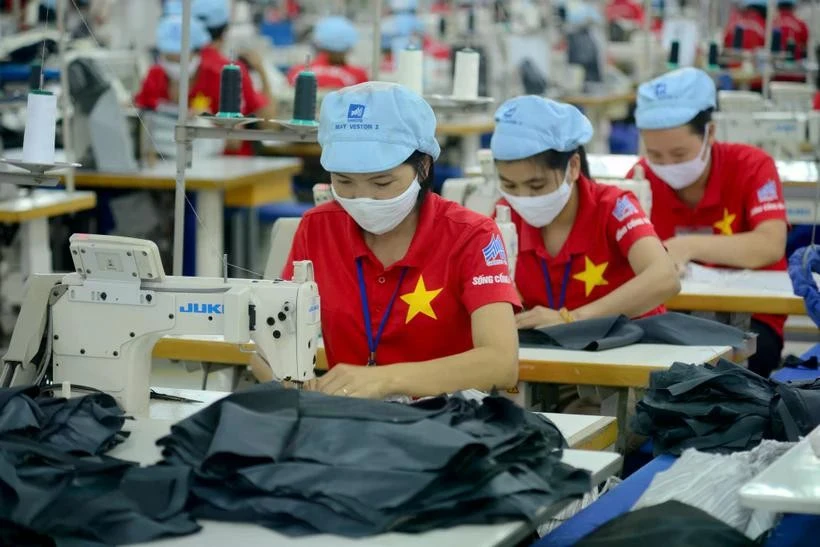
Vietnam's Apparel & Textile Export Industry
H1 2026 — Review & H2 2026 Outlook
Published by: SmartKey Platform — Market Intelligence Unit | Afinest Partners Publication Date: August 2026 Data Sources: VITAS, Vinatex, VietnamPlus/VNA, Vietnam News, VnEconomy, Reuters, Vietnam Customs Authority (Ministry of Finance)
I. H1 2026 — KEY FIGURES AT A GLANCE
Vietnam's textile and garment export landscape in the first half of 2026 recorded positive yet cautious growth — a reflection of an industry navigating a profoundly complex global trade and geopolitical environment.
According to official data released by the Vietnam Textile and Apparel Association (VITAS) at its Second Executive Committee Conference of the VII Tenure (2025–2030), total industry export turnover for the first six months of 2026 reached an estimated USD 22.199 billion, representing a year-on-year increase of 1.7% compared to H1 2025. The industry's trade surplus reached approximately USD 10.5 billion — a commendable achievement given that global consumer demand has yet to fully recover.
Entering July 2026, momentum accelerated noticeably. July alone recorded export turnover of USD 4.672 billion, up 8.2% from June 2026 and up 4.3% year-on-year versus July 2025. The cumulative seven-month figure stood at USD 27.02 billion, up 2.67% compared to the same period in 2025.
Key Performance Summary — H1 2026:
IndicatorValueYoY Growth
Total Textile & Garment Exports H1/2026
$22.199 billion
+1.7%
Garment & Apparel Exports
$17.25 billion
-0.32%
Fibre & Yarn Exports
$2.288 billion
~+10%
Fabric Exports
$1.481 billion
+8.9%
Accessories & Ancillary Materials
Positive growth
+10.81%
H1 Trade Surplus
~$10.5 billion
Positive
Raw Material Imports
$13.007 billion
+2.4%
(Sources: VITAS, Vietnam News, VietnamPlus/VNA, July 2026)
II. KEY EXPORT MARKET ANALYSIS
United States — The Dominant Market Under Significant Tariff Pressure
The United States continues to hold its position as Vietnam's largest textile and garment export destination. In the first five months of 2026, export turnover to the US reached USD 6.81 billion, up 1.3% year-on-year, accounting for approximately 45% of total export market share. Notably, Vietnam was among a very small number of exporting nations that maintained positive growth in the US market during a period when total US textile and garment import demand contracted by a significant 12.06%.
However, the US market simultaneously represents the most substantial legal and trade policy risk facing the industry. According to Reuters (24 July 2026), Vietnam currently faces a 12.5% tariff rate in the United States — on par with China — while key competitors such as Bangladesh and Cambodia benefit from lower rates, placing Vietnam at a structural competitive disadvantage in the world's largest apparel import market.
More pressingly, the Section 301 investigation by the US Trade Representative (USTR) — examining allegations related to forced labour practices and industrial overcapacity — carries the potential for additional tariff imposition of 10% to 12.5% across 54 trading partners, including Vietnam. Should this proceed, the implications for Vietnamese exporters would be severe, particularly for enterprises with high US market concentration.
European Union — The Standout Growth Market of H1 2026
The European Union emerged as the clearest bright spot in Vietnam's export market diversification story during the first half of 2026. Exports to the EU reached USD 1.94 billion, up 8.8% year-on-year — the strongest growth rate recorded across all major export markets. This result reflects Vietnamese enterprises' increasingly effective utilisation of preferential tariff rates under the EU–Vietnam Free Trade Agreement (EVFTA), as the progressive elimination of duties on qualifying garments meeting the two-stage rules-of-origin criteria continues to yield tangible commercial benefits.
Japan & South Korea — Two Markets of Concern
In contrast to the EU's strong performance, exports to Japan and South Korea — two of Vietnam's most established traditional markets — recorded concerning declines. Exports to Japan fell 6.2% and exports to South Korea dropped 8.9% in the first five months of 2026. The primary drivers of this contraction include weakened domestic consumer purchasing power in both markets, currency depreciation reducing the relative competitiveness of imports, and structural shifts in retail purchasing patterns among Japanese and Korean fashion brands.
III. PRODUCT STRUCTURE ANALYSIS — AN UPSTREAM SHIFT IN THE VALUE CHAIN
One of the most structurally significant signals emerging from H1 2026 is the pronounced divergence between finished garment exports and upstream raw material categories.
While finished garments and apparel — which remain the largest single export category at over USD 17.25 billion — recorded a slight decline of 0.32%, reflecting subdued demand in key destination markets, the upstream categories of fibres, yarns, fabrics, and accessories surged impressively, posting growth rates ranging from 8.9% to 10.81%. This structural shift signals that Vietnam's textile and garment industry is gradually moving away from a pure contract manufacturing model, progressively capturing higher value-added stages within the global supply chain.
By the end of July 2026, cumulative fibre and yarn exports reached USD 2.730 billion (+11.34%), accessories and ancillary materials reached USD 929 million (+11.18%), and fabric exports reached USD 1.763 billion (+9.57%) — all demonstrating that Vietnam's upstream textile sector is gaining meaningful international traction.
IV. CORE INDUSTRY CHALLENGES
Raw Material Dependency — A Long-Term Structural Vulnerability
Vietnam's textile and garment industry continues to rely on imported raw materials for approximately 60–70% of total production inputs. In H1 2026 alone, raw material imports reached USD 13.007 billion, with fabric imports from China accounting for USD 5.53 billion — a dependency that materially constrains the industry's ability to fully leverage the preferential tariff benefits offered by the EVFTA and CPTPP, both of which enforce strict two-stage rules-of-origin requirements.
Margin Compression and Pricing Pressure
VITAS has documented broad-based commercial pressure across the industry: unit prices are being driven lower by global brand sourcing teams, order volumes are smaller and more fragmented, delivery lead times are shortening, while input costs, logistics expenses, and ESG compliance expenditures are simultaneously rising. Vinatex CEO Cao Huu Hieu confirmed that profit margins across both the yarn-spinning and garment manufacturing segments are under sustained pressure.
ESG Standards and Supply Chain Traceability Requirements
The EU and US markets are imposing increasingly stringent requirements related to corporate social responsibility, carbon emissions reduction, circular economy practices, and raw material traceability. These requirements are no longer voluntary commitments — they have become commercially mandatory conditions for retaining sourcing relationships with major global fashion brands. Vietnamese enterprises that fail to invest in ESG compliance risk losing their positions in premium global supply chains regardless of their price competitiveness.
V. LEADING ENTERPRISE PERFORMANCE — VINATEX H1 2026
Vietnam National Textile and Garment Group (Vinatex) — the industry's flagship state enterprise — reported consolidated net revenue of VND 9,494 billion in H1 2026, up 9.2% year-on-year. Pre-tax profit reached VND 930.4 billion, a substantial increase of 39.5% compared to the same period in 2025, representing the completion of approximately 66% of its full-year profit plan at the halfway mark of the year. This result reflects the effectiveness of Vinatex's internal restructuring, cost discipline, and supply chain optimisation initiatives, even as the broader operating environment remains challenging.
(Sources: VnEconomy, Bao Dau Tu, VietnamPlus — July 2026)
VI. H2 2026 FORECAST & SCENARIO ANALYSIS
Full-Year Target and Second-Half Imperatives
VITAS has set a full-year 2026 export target of USD 48 billion (optimistic scenario) or a minimum of USD 47.5 billion (base scenario). With H1 delivering USD 22.2 billion, the industry must sustain average monthly export turnover of more than USD 4 billion throughout the remaining six months to reach its annual goal. The July 2026 figure of USD 4.672 billion demonstrates that this pace is achievable — however, July is historically a peak production month, and sustaining this momentum through the remainder of the year will require deliberate strategic execution.
Optimistic Scenario (Estimated probability: ~40%)
The industry achieves its USD 48 billion target if US–Vietnam trade negotiations yield meaningful progress and the Section 301 investigation concludes without imposing additional tariffs; consumer demand in the EU and US recovers in line with the traditional Q4 peak retail season; and Vietnamese enterprises successfully execute market diversification strategies into emerging high-potential markets including Canada, Australia, the Middle East, and Central Asia.
Base Scenario (Estimated probability: ~45%)
The industry achieves approximately USD 46–47.5 billion, representing full-year growth of 4–6% compared to 2025. Enterprises maintain order books through flexibility in order scale and delivery speed, while the EU continues to serve as the primary offset market compensating for weakness in Japan and South Korea. This scenario assumes no material escalation in US tariff policy during H2 2026.
Cautious Scenario (Estimated probability: ~15%)
Should the Section 301 investigation result in additional tariffs of 10–12.5% on Vietnamese goods, compounded by a continued strong US dollar suppressing American consumer purchasing power for imported goods, total annual export turnover may fall to USD 44–46 billion. This scenario would disproportionately impact enterprises with over 60% market concentration in the United States, potentially triggering order migration to lower-tariff competing countries.
VII. INDUSTRY STRATEGY FOR H2 2026
VITAS has formally approved a comprehensive strategic restructuring framework, with four dedicated specialised committees scheduled for pilot implementation from Q3 2026 onwards.
The Fashion Committee will focus on developing Vietnam's domestic market — estimated at USD 5.5 billion in addressable demand across a population of over 100 million — building Vietnamese fashion brands for the home market as a strategically important buffer against over-dependence on export markets.
The International Enterprise Committee will concentrate on strengthening global supply chain connectivity, attracting high-quality FDI into upstream manufacturing segments — specifically weaving, dyeing, and finishing — to address the industry's most critical structural bottleneck: raw material self-sufficiency.
The Sustainable Development Committee will drive the adoption of circular economy practices, ESG implementation, carbon emissions reduction, and eco-design standards required by the EU's forthcoming regulatory frameworks and increasingly mandatory US supply chain due diligence requirements.
The Technology & Digital Transformation Committee will support enterprises in implementing AI-powered production planning, factory automation, and smart manufacturing systems to optimise costs and improve order fulfilment performance at scale.
Concurrently, VITAS has formally petitioned the Vietnamese Government to accelerate negotiations of the ASEAN–Canada Free Trade Agreement, resume progress on the Vietnam–EAEU FTA, provide government-level negotiating support with the United States regarding the Section 301 investigation, and consider VAT exemption or deferral on domestically produced raw materials incorporated into the export manufacturing supply chain.
VIII. STRATEGIC IMPLICATIONS FOR BUSINESSES & INVESTORS
Vietnam's textile and garment export industry is entering a pivotal growth model transformation — moving away from volume-driven, low-cost-labour competitive advantages toward productivity-led, value-added, and global standards-compliant growth. This transition simultaneously presents challenges and an opportunity for natural market consolidation, in which enterprises that invest in technology, green supply chains, and market diversification will emerge as the sector's long-term leaders.
For foreign investors and strategic partners, the most compelling opportunities in H2 2026 and beyond are concentrated in upstream investment in weaving, dyeing, and finishing capacity; recycled fibre and sustainable raw material supply chains; and smart factory technology — precisely the missing components in Vietnam's textile value chain that represent both the industry's most critical vulnerability and its greatest long-term investment opportunity.
For international buyers and sourcing teams, Vietnam remains one of the most compelling global sourcing destinations, combining competitive manufacturing capability, improving ESG compliance posture, and a government actively committed to maintaining and expanding its global trade relationships. The risk is real — but so is the resilience.
DATA SOURCES & REFERENCES
VITAS — Vietnam Textile and Apparel Association, 2nd Executive Committee Conference VII/2026 (vietnamtextile.org.vn)
VietnamPlus / Vietnam News Agency (VNA) — "Textile and garment exports reach over $27 billion in seven months", August 2026
VnEconomy — "Textile industry reshapes strategy to reach $48 billion export target", July 2026
Vietnam News (VNS) — "Textile and garment sector posts nearly $10 billion trade surplus in H1", July 2026
Bao Dau Tu (Vietnam Investment Review) — "Vinatex records VND 930 billion profit in H1 2026", July 2026
Reuters — "Top apparel exporter Vietnam faces higher US tariffs than peers", 24 July 2026
Tuoi Tre News — "New US tariffs may affect Vietnam textile orders and supply chains", August 2026
Vietnam Customs Authority, Ministry of Finance — Export & import statistical data, June 2026
This report was researched and compiled by the SmartKey Platform — Market Intelligence Unit, a division of Afinest Partner Consultant International Vietnam LTD. All figures and statistics cited are sourced from publicly verifiable, authoritative sources. This report is intended for informational and reference purposes only and does not constitute investment advice.
smartkey.io.vn | Smart Business Matching — Powered by Afinest Partners